Summary:
You called three contractors and got three different numbers. One quoted $4 a square foot. One quoted $8. The third would not give you anything until he walked the property. It is hard to tell from the outside whether you are looking at a fair spread or getting worked.
Here is the honest version. Asphalt driveway cost in NJ sits in a real range, the spread between quotes is usually explainable, and once you know what sits behind the number you can tell a serious estimate from a lowball in about thirty seconds. That is what the rest of this page is for.
What an asphalt driveway costs in New Jersey
An asphalt driveway in New Jersey costs about $3.50 to $7 per square foot installed, with published NJ pricing guides putting the higher end of the market closer to $5 to $8. For a standard 600 square foot two car driveway, that works out to roughly $3,000 to $4,800 for a full tear out and replacement.
Those are installed prices. They cover removing the old surface, prepping and compacting the base, laying hot mix asphalt at the right thickness, and rolling it for density. A number that only covers the asphalt itself is not a driveway price, it is a materials price, and the two get confused constantly.
Resurfacing is the cheaper path when the base underneath is still sound. You are paying for a new top layer instead of a new driveway, and it typically lands well under the full replacement range. The catch is that resurfacing a failed base buys you two or three years, not twenty. If you are weighing asphalt against a poured slab, we put the full comparison in our concrete driveway cost guide rather than repeating it here.
Asphalt driveway cost per square foot by driveway size
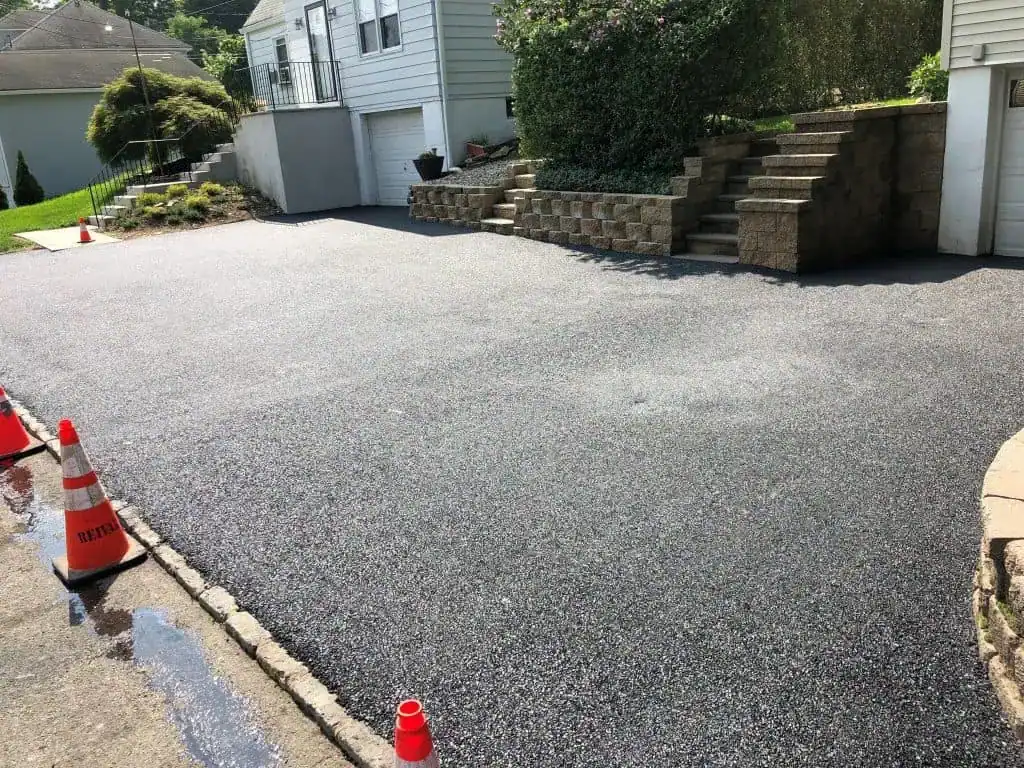
Per square foot pricing is useful for comparing quotes and useless for budgeting, because nobody knows their square footage off the top of their head. Here is the same range converted into driveways people actually have.
- 400 square feet, single car: roughly $1,400 to $2,800 for a full replacement. Small jobs carry the worst per foot rate because the crew, the truck and the roller cost the same whether they pave 400 feet or 4,000.
- 600 square feet, standard two car: roughly $3,000 to $4,800. This is the most common residential job in Morris, Sussex and Somerset County and the number most quotes are built around.
- 1,000 square feet, two car with a turnaround or a longer approach: roughly $3,500 to $7,000.
- 1,500 square feet, long rural driveway: roughly $5,250 to $10,500, and this is where the per foot rate finally starts working in your favor.
One real market data point, because ranges can feel abstract. A New Jersey homeowner posting publicly in 2026 was quoted $4,800 for 580 square feet including new steel drains. That is about $8.28 a square foot, above the typical range, and the drains are why. Drainage work is the single most common reason a quote lands above the band.
Resurfacing instead of replacing. If the base under your driveway is still solid, you are not buying a new driveway, you are buying a new surface. An overlay typically runs somewhere between a third and a half of the replacement figures above, so that same 600 square foot two car driveway lands nearer $1,200 to $2,400 than $3,000 to $4,800.
The question is never whether resurfacing is cheaper. It always is. The question is whether your base has failed, because an overlay on a failed base is the most expensive cheap decision in this trade. Three signs the base is gone: alligator cracking, which looks like interconnected scales rather than single lines; sunken ruts where the wheels sit; and water that pools in the same spot after every rain. Any of those and an overlay buys you two or three winters at most. None of those, and resurfacing is the right call and we will tell you so.
If every number here is more than you want to spend, tar and chip is the genuine budget alternative rather than a cheaper asphalt job. We cover what it costs and where it makes sense in our tar and chip driveway cost guide.
What changes your asphalt paving cost
Two driveways of identical size can be quoted $2,000 apart and both quotes can be honest. These are the things doing the work.
- Tear out and disposal. Removing and hauling an old driveway is real labor and real dump fees. Paving over the top skips that cost and usually skips the lifespan with it.
- Base depth. North Jersey soil holds water, and a base built for a southern climate will heave here. A thicker compacted stone base costs more up front and is the difference between fifteen years and five.
- Drainage. Grading, channel drains, catch basins. If water pools on your driveway or runs toward the house, that gets fixed during the job or it destroys the job.
- Access. A crew that cannot get a truck and a paver to the work adds hours. Tight approaches, low branches and steep grades all show up in the price.
- Slope. A driveway on a real grade needs more material, more compaction attention and sometimes edge work to stop the asphalt creeping.
Those are the legitimate reasons a number moves. There is a second category, the costs that appear after the contract is signed, and we wrote about those separately in the hidden costs that blow a driveway paving budget.
Want live answers?
Connect with a Platinum Paving expert for fast, friendly support.
How thick asphalt should be on a New Jersey driveway
Two inches of compacted asphalt is the bare minimum for a residential driveway, and in this climate it is not what we would put down. Three inches over a properly compacted base is the standard we work to for a driveway carrying normal cars, and four inches or more where there are trucks, a boat, or an RV.
The reason is freeze and thaw. North Jersey runs roughly 40 percent more freeze thaw cycles a winter than the southern half of the state. Water gets into the surface, freezes, expands, and pushes. A thin mat over a thin base has nothing to resist that, which is why so many driveways here crack in their second or third winter and the owner assumes they got bad asphalt. Usually they got thin asphalt.
Ask any quote two questions: how many inches of compacted asphalt, and how many inches of compacted base under it. A contractor who will not give you both numbers in writing is a contractor who intends to decide on the day.
New Jersey asphalt paving prices versus the national average
Published pricing guides put New Jersey roughly 15 to 25 percent above the national average for asphalt paving. That gap is real and it is not contractors taking advantage of the zip code.
Three things drive it. Construction wages here are among the highest in the country. The freeze thaw climate means base depths and asphalt mixes that a contractor in a mild state would never need to quote. And most municipalities here require permits and inspections that add both fees and days to a job.
This is worth knowing before you compare a quote against a number you found on a national cost calculator. Those calculators are averaging in states where the ground does not move, and a New Jersey driveway built to a national average spec is a driveway built to fail early.
Do you need a permit to repave a driveway in New Jersey
Usually not for a like for like replacement inside the existing footprint. Usually yes the moment you widen the driveway, change the grade, or alter how water leaves your property. Commercial work and anything touching a county road almost always needs one.
It varies by municipality, which is the frustrating part. What passes without paperwork in one Morris County town needs an application and an inspection in the next one over. A contractor who works your area should already know which, and should be pulling it rather than leaving it with you.
The cost is usually modest next to the job itself, but an unpermitted driveway becomes a real problem at closing when you sell. We broke the fees down town by town in our guide to what NJ counties actually charge for a driveway permit.
Cheap asphalt driveway quotes in NJ
When a quote comes in well under the ranges on this page, it is not usually a bargain. It is usually a different job. Here is what the gap tends to be.
The myth: a lower price per square foot means a better deal.
The reality: the price per square foot is only comparable when the specs are. Two inches over a thin base will always beat three inches over a proper base on price, and lose on every other measure.
The myth: the old driveway can just be paved over.
The reality: sometimes, if the base is genuinely sound. Often it is the cheap way to hide a failing base, and the new surface follows the old one apart.
The myth: cold patch and leftover mix are fine for a driveway.
The reality: hot mix has to go down hot and be compacted while it is hot. Material that has cooled in the truck never reaches proper density, and it starts shedding within a year or two.
The myth: drainage can wait.
The reality: water is what destroys asphalt in this state. A quote that says nothing about grading or drainage is a quote that is planning to leave your water problem exactly where it is.
If you want a real number for your driveway rather than a range, we will walk the property, measure it, and put the base depth and the asphalt depth in writing. See what we cover on our asphalt paving page, or request a free quote and we will come out. No pressure and no upselling, just what the driveway actually needs.