Summary:
You’ve probably noticed your driveway is past its prime. Maybe it’s the cracks spreading every spring, the drainage issues after heavy rain, or just the fact that it looks tired compared to the rest of your property. Now you’re trying to figure out what a replacement actually costs—and whether concrete makes sense for your budget and your climate.
The numbers you’ll find online are all over the place. Some sources say $4 per square foot, others say $15. That’s not helpful when you’re trying to plan a real project with a real budget. What you actually need is pricing that reflects current material costs, local labor rates, and the specific challenges of installing a driveway in North Jersey that has to survive freeze-thaw cycles, heavy snow, and everything else Sussex County winters throw at it.
Here’s what concrete driveways actually cost in 2026, how that compares to asphalt, and what drives the price up or down for your specific situation.
Cost of Concrete Driveway: Complete Price Breakdown
Concrete driveways in New Jersey typically cost between $6 and $15 per square foot installed. That’s the complete price—materials, labor, site prep, everything. For a standard two-car driveway around 600 square feet, you’re looking at $3,600 to $9,000 depending on thickness, site conditions, and whether you want plain gray concrete or something with more visual interest.
The wide range isn’t because contractors are making up numbers. It’s because your project isn’t the same as your neighbor’s. A straightforward replacement on level ground with good drainage costs less than a sloped driveway that needs extensive grading work and a new base. Thicker concrete for heavier vehicles costs more than standard residential thickness. Decorative finishes cost more than a basic broom finish.
Here’s what actually goes into that per-square-foot price. Materials—the concrete itself, rebar or wire mesh reinforcement, and forms—typically account for 40 to 60 percent of your total cost. Labor and equipment make up most of the rest. An experienced crew can prep and pour about 15 to 20 square feet per hour, and labor rates in North Jersey run $40 to $55 per hour on average.
What Affects Your Concrete Driveway Cost Per Square Foot
Size matters, but probably not the way you think. Larger driveways cost more in total dollars, but they often have a lower price per square foot because you’re spreading fixed costs like equipment rental and mobilization across more area. A 400-square-foot driveway might run $12 per square foot while an 800-square-foot driveway from the same contractor costs $9 per square foot.
Thickness is where a lot of homeowners make expensive mistakes. Standard residential driveways need 4 inches of concrete minimum. That works fine for cars and light trucks. But if you park heavier vehicles, an RV, or you’re in an area with aggressive freeze-thaw cycles—which describes most of Sussex County—you want 5 to 6 inches. The edges should be even thicker, 6 to 8 inches, to prevent cracking at the most vulnerable points. Skimping on thickness to save money upfront usually means premature cracking and a shorter lifespan.
Site preparation can easily account for 30 to 40 percent of your project cost, and it’s the part that separates driveways that last from driveways that fail. If your existing driveway needs to be removed, add about $1 per square foot for tear-out and disposal. If the site needs grading to correct drainage or create the right slope, that runs $2 to $25 per square foot depending on how much work is required. Poor soil conditions might need additional base material or stabilization.
The base itself is critical. A proper installation includes 4 to 6 inches of compacted gravel or crushed stone. This layer distributes weight, prevents settling, and allows water to drain away from the concrete. Contractors who skip proper base prep or don’t compact it adequately are setting you up for problems down the road. You’ll see settling, cracking, and drainage issues within a few years.
Reinforcement adds cost but prevents bigger costs later. Wire mesh is standard and adds minimal expense. Rebar on 24-inch centers costs more but provides superior crack control, especially on longer driveways or in areas with challenging soil conditions. Some contractors also add fiber reinforcement—polypropylene or steel fibers mixed into the concrete—for additional crack resistance. It’s a small upcharge that can significantly extend your driveway’s life.
Finishing affects both appearance and price. A basic broom finish provides good traction and costs the least. Stamped concrete that mimics brick, stone, or tile adds $10 to $28 per square foot depending on pattern complexity. Colored or stained concrete adds $7 to $15 per square foot. These upgrades are purely aesthetic, but they can dramatically improve curb appeal if that matters for your situation.
Blacktop Driveway Cost vs Concrete: The Real Numbers
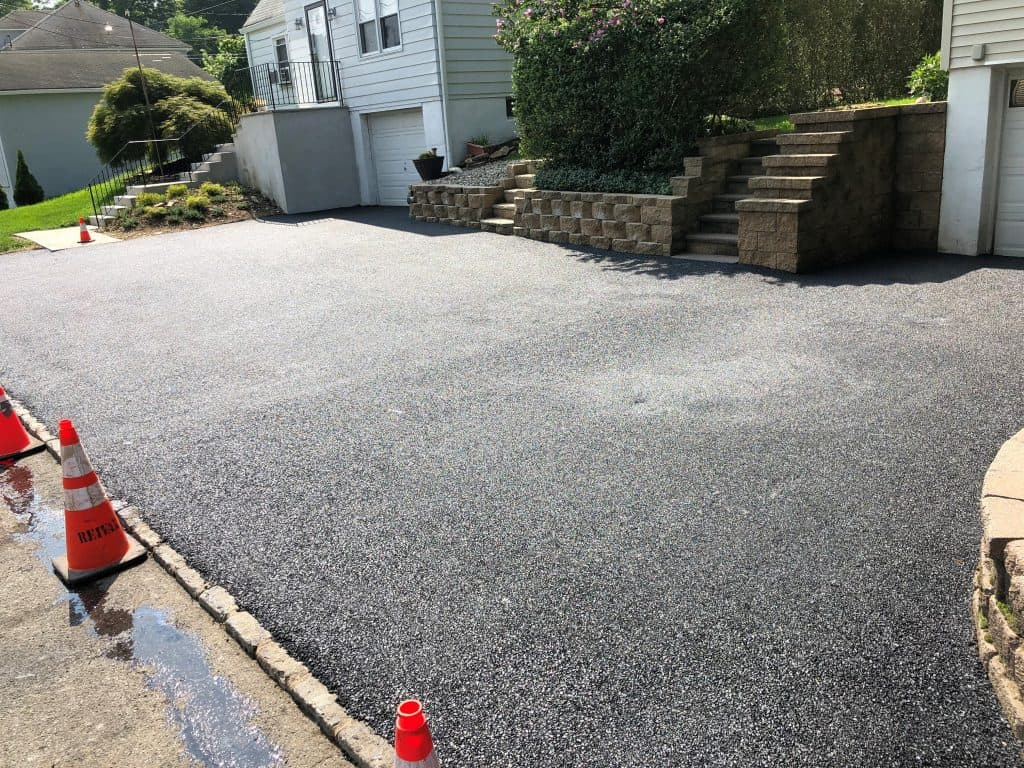
Asphalt—also called blacktop—costs less upfront than concrete. That’s the headline number everyone focuses on. Asphalt installation typically runs $3 to $7 per square foot in New Jersey, compared to $6 to $15 for concrete. For that same 600-square-foot driveway, you’re looking at $1,800 to $4,200 for asphalt versus $3,600 to $9,000 for concrete.
But upfront cost is only part of the equation. Asphalt requires sealing every 3 to 5 years to protect against water damage and UV deterioration. That costs $500 to $1,000 each time. Around the 15-year mark, you’re looking at resurfacing for $1,500 to $3,000. Concrete needs minimal maintenance—optional sealing every few years to enhance appearance, but it’s not required for structural integrity.
When you run the numbers over the actual lifespan of each material, the cost difference shrinks considerably. An asphalt driveway typically lasts 15 to 20 years with proper maintenance. A concrete driveway lasts 30 to 40 years, sometimes longer. Over 30 years, that 600-square-foot concrete driveway might cost $6,500 to $8,000 total when you factor in minimal maintenance. The asphalt driveway could cost $8,000 to $10,000 when you include regular sealing, repairs, and eventual resurfacing or replacement.
Climate plays a bigger role than most homeowners realize. Asphalt performs well in cold climates because it’s flexible—it can handle freeze-thaw cycles without cracking as easily as concrete. But it softens in extreme heat, which isn’t usually a problem in New Jersey. Concrete handles heat better but can crack in areas with frequent temperature fluctuations if it’s not properly installed with air-entrained mix.
Here’s the thing about New Jersey specifically. We get 40-plus freeze-thaw cycles every winter in North Jersey. That’s significantly more than Central or South Jersey. Both materials can handle it, but only if they’re installed correctly. For concrete, that means using air-entrained mix with 5 to 7 percent air content—tiny air bubbles that give water somewhere to expand when it freezes. For asphalt, it means proper thickness and a stable base. We make sure these details are handled because we understand local conditions.
The decision often comes down to your priorities. If you need the lowest possible upfront cost and don’t mind regular maintenance, asphalt works. If you want to install it once and not think about it for decades, concrete makes more sense despite the higher initial price. If aesthetics matter—you want color, pattern, or a specific look—concrete offers options that asphalt simply can’t match.
Want live answers?
Connect with a Platinum Paving expert for fast, friendly support.
Asphalt vs Concrete Driveway Price: Side-by-Side Comparison
Let’s put actual numbers next to each other so you can see what you’re comparing. For a standard 600-square-foot two-car driveway in Sussex County, asphalt installation costs $2,400 to $4,800. Concrete installation for the same driveway costs $3,600 to $9,000. That’s a difference of $1,200 to $4,200 upfront.
Now add maintenance over time. Asphalt needs sealing every 3 to 5 years at $500 to $1,000 per application. Over 20 years, that’s 4 to 6 sealings for $2,000 to $6,000 in maintenance costs. You might also need crack filling, pothole repairs, and eventually resurfacing. Concrete might get sealed once or twice for appearance, but it’s optional—call it $0 to $1,000 over the same period.
Material lifespan changes the math significantly. If your asphalt driveway lasts 18 years and your concrete driveway lasts 35 years, you’re replacing the asphalt nearly twice in the time the concrete is still going strong. That second asphalt installation adds another $2,400 to $4,800 to your total cost of ownership.
Cost of Asphalt vs Concrete: What You're Actually Paying For
The materials themselves are fundamentally different, which explains some of the price difference. Asphalt is a petroleum-based product—aggregate held together with bitumen, a byproduct of oil refining. Concrete is cement, sand, and aggregate mixed with water. Asphalt prices fluctuate with oil prices, typically rising about 0.7 percent for every 1 percent increase in crude oil costs. Concrete prices are more stable but have increased with inflation like everything else.
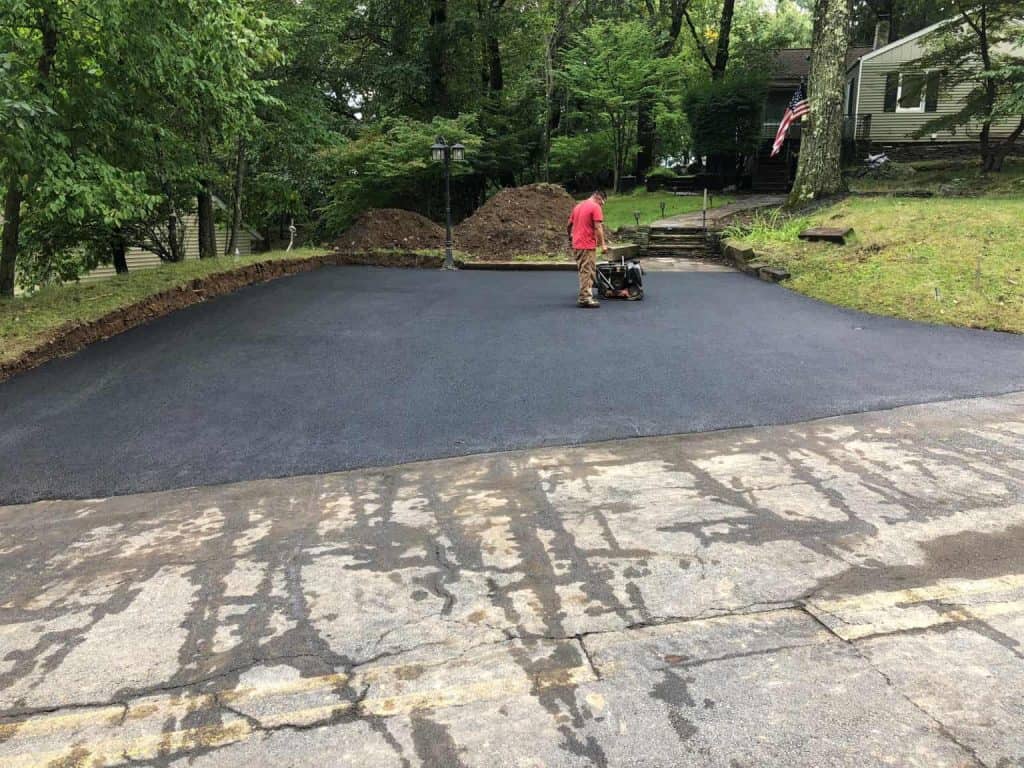
Installation processes differ in ways that affect labor costs. Asphalt is delivered hot and needs to be rolled and compacted quickly before it cools. The process is faster than concrete—most asphalt driveways can be installed in a day and driven on within 24 to 48 hours. Concrete requires forming, pouring, finishing, and then a curing period. You’re typically waiting 7 days before you can drive on new concrete, though you can walk on it sooner.
That curing time is critical for concrete’s long-term performance. Contractors who rush it or don’t protect the concrete properly during curing are creating problems you’ll see within a few years. Proper curing means keeping the concrete moist or applying curing compound for the first week. It prevents the surface from drying too fast, which causes shrinkage cracks.
The skill level required differs too. Both materials need experienced crews, but concrete finishing is less forgiving. Once it’s poured, you have a limited window to get the surface right before it starts to set. Mistakes can’t be easily fixed. Asphalt is more forgiving during installation, though proper base prep and compaction are just as critical for both materials.
Repair costs tell another part of the story. When asphalt develops cracks or potholes, repairs are relatively straightforward and inexpensive. You can patch small areas without it being obvious. When concrete cracks, repairs are more visible and often more expensive. But concrete cracks less frequently if it’s installed properly, so you’re dealing with repairs less often.
Climate suitability affects long-term costs in ways that aren’t obvious from the installation price. In North Jersey’s climate with frequent freeze-thaw cycles, both materials can perform well—but only if they’re installed with the right specifications. Concrete needs air entrainment and adequate thickness. Asphalt needs proper compaction and regular sealing. Contractors who cut corners on these details deliver driveways that fail prematurely, regardless of which material you choose.
Price of Asphalt vs Concrete: Making the Right Choice for Your Budget
The right choice depends on factors beyond just the price tag. How long do you plan to stay in your home? If you’re selling in the next few years, the lower upfront cost of asphalt might make more sense. If this is your forever home, concrete’s longevity and lower maintenance could save you money and hassle over decades.
What kind of vehicles do you park? Standard cars and SUVs are fine on either material with proper thickness. If you regularly park heavy trucks, RVs, or commercial vehicles, concrete’s superior load-bearing capacity makes it the better choice. Asphalt can soften under heavy loads, especially in summer heat, creating depressions and ruts.
How much do you care about appearance? If you want your driveway to look a specific way—maybe match your walkway or complement your home’s architecture—concrete offers customization that asphalt can’t match. Stamped patterns, integral color, decorative borders, all of these are possible with concrete. Asphalt is black, period. Some contractors can add tints or sealers with slight color variation, but your options are limited.
What’s your tolerance for maintenance? Be honest about this. If you’re the type who stays on top of home maintenance and doesn’t mind scheduling sealcoating every few years, asphalt works fine. If you want to install something and not think about it again for 20 years, concrete fits that approach better.
Local conditions matter more than national averages. Sussex County’s winters are tough on driveways. Freeze-thaw cycles, road salt, heavy snow loads—these are real factors that affect how materials perform. Working with a contractor who understands local conditions and uses appropriate specifications for this climate makes a bigger difference than the material choice itself.
Here’s something most pricing guides won’t tell you. The quality of installation matters more than the material you choose. A properly installed asphalt driveway will outlast a poorly installed concrete driveway every time. Proper base preparation, adequate thickness, appropriate reinforcement, correct drainage—these fundamentals determine whether your driveway lasts 15 years or 35 years. Don’t choose based on material alone. Choose based on the contractor’s knowledge, their installation standards, and their understanding of what works in North Jersey.
Budget for the project realistically. Your total cost includes more than just the driveway itself. Factor in removal of your existing driveway if needed. Account for any grading or drainage work. Include permits if your municipality requires them. Some towns in New Jersey require permits for driveway work, especially if you’re changing the footprint or affecting drainage. A good contractor handles this for you, but it’s still a cost to consider.
Getting Accurate Concrete Driveway Cost Estimates for Your Project
The numbers in this guide give you a realistic starting point, but your actual cost depends on your specific situation. The only way to know what your project will cost is to have contractors evaluate your site, understand your goals, and provide detailed estimates based on current material and labor costs.
Get at least three quotes from contractors with experience in North Jersey. Make sure they’re looking at the same scope of work—same thickness, same base preparation, same finishing. Ask what’s included and what’s not. Verify they understand local soil conditions and climate requirements. Check that they’re using appropriate specifications like air-entrained concrete for freeze-thaw resistance.
The lowest bid isn’t always the best value. Contractors who cut corners on base prep, thickness, or curing are delivering a driveway that will fail prematurely. You’ll spend less upfront and more over time dealing with repairs and early replacement. Quality installation costs more initially but delivers decades of reliable service.
We work with homeowners throughout Sussex County who need transparent pricing and quality installation that’s built for local conditions. If you’re ready to move forward with your driveway project, reach out for a detailed estimate based on your specific site and requirements.