Summary:
Your driveway takes a beating. Every winter in Sussex County brings freeze-thaw cycles that crack pavement from the inside out. Every spring reveals the damage—potholes, crumbling edges, water pooling near your foundation. You know you need a solution, but the options feel overwhelming. Hot mix, blacktop, tar and chip, recycled asphalt—what’s the actual difference, and which one will still look good in ten years? This guide cuts through the confusion. You’ll see exactly what each asphalt driveway type offers, how it performs in our climate, and what it costs. By the end, you’ll know which option fits your property, your budget, and your tolerance for maintenance.
Asphalt Driveway Basics: What You're Actually Getting
An asphalt driveway isn’t just black pavement. It’s an engineered system designed to handle weight, weather, and time. At its core, asphalt combines aggregate (crushed stone, gravel, sand) with bitumen—a petroleum-based binder that holds everything together. The ratio of these materials, the temperature during mixing, and the installation process determine how well your driveway performs.
In Sussex County, that performance matters more than in milder climates. Your driveway needs to flex when temperatures swing from 20°F to 50°F in a single week. It needs to shed water quickly so moisture doesn’t freeze in cracks and tear the surface apart. It needs a base that won’t shift in our clay soil. Getting these fundamentals right means the difference between a driveway that lasts 20 years and one that needs major repairs after three winters.
The five types covered here all use asphalt, but they differ in composition, application method, durability, and cost. Some prioritize longevity. Others focus on budget or aesthetics. Understanding what you’re actually paying for helps you choose wisely instead of just picking the cheapest quote.
Hot Mix Asphalt: The Gold Standard for Durability
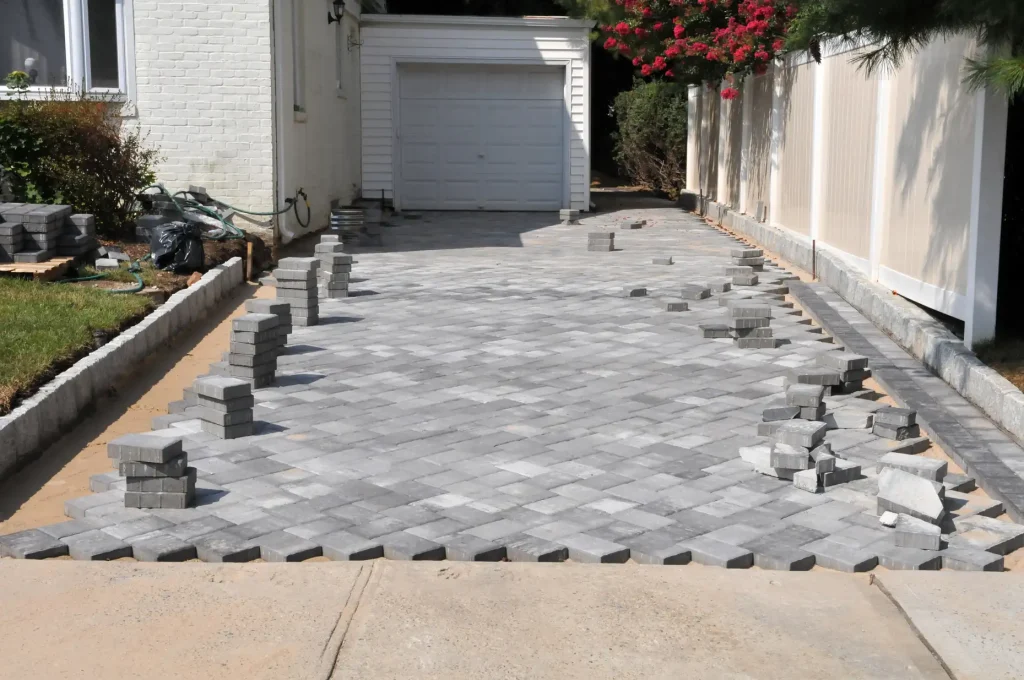
Hot mix asphalt (HMA) is what most people picture when they think “asphalt driveway.” We heat the material to 300-350°F before application, which makes it workable and allows for thorough compaction. Once it cools, you get a dense, smooth surface that handles heavy loads and resists water penetration.
The heating process is what gives HMA its strength. High temperatures ensure the bitumen fully coats every piece of aggregate, creating a tight bond that holds up under stress. This matters in Sussex County, where freeze-thaw cycles happen 40 to 50 times each winter. Water that seeps into poorly bonded asphalt expands when it freezes, generating thousands of pounds of pressure per square inch. That pressure cracks weak surfaces from the inside. Hot mix asphalt, when installed correctly, resists this infiltration better than any other option.
You’ll pay more upfront for HMA—typically $5 to $7 per square foot installed in New Jersey. A standard two-car driveway runs $3,500 to $5,500. That’s 15-25% higher than the national average, driven by our higher labor costs, stricter permits, and the need for thicker base layers to handle our climate. But the investment pays off. A properly installed hot mix asphalt driveway lasts 15 to 25 years with basic maintenance, compared to 7 to 10 years for cheaper alternatives.
Maintenance requirements are straightforward. Wait 6 to 12 months after installation, then apply a sealcoat to protect against UV damage and water penetration. Repeat every 2 to 3 years. Fix small cracks promptly before they spread. Keep the surface clean. Follow this routine, and your driveway will outlast most of your neighbors’ while looking better the entire time.
The downside? Hot mix needs to be installed in warm weather—generally when temperatures stay above 50°F. That limits your window to late spring through early fall in Sussex County. You also can’t drive on it for 24 to 48 hours after installation, which requires some planning. And in extreme heat, asphalt can soften slightly, though this rarely causes problems with residential driveways.
When Hot Mix Asphalt Makes the Most Sense
Hot mix asphalt works best when durability matters more than initial cost. If you’re planning to stay in your home long-term, the higher upfront investment pays for itself through lower maintenance costs and fewer repairs. You won’t be dealing with major resurfacing projects every 7 years or patching potholes every spring.
It’s also the right choice for driveways that see heavy use. Multiple vehicles, frequent traffic, delivery trucks—hot mix handles the load without developing ruts or soft spots. The dense, well-compacted surface distributes weight evenly, preventing the kind of localized damage that plagues weaker materials.
Sussex County’s climate makes hot mix particularly valuable. Our freeze-thaw cycles are relentless. Temperatures hover around freezing for weeks, creating constant expansion and contraction. Water infiltration is your biggest enemy, and hot mix asphalt’s tight, non-porous surface keeps moisture out better than any alternative. That protection translates directly into longevity.
Consider hot mix if your property has drainage challenges. Hilly terrain, clay soil, areas where water naturally flows—these situations demand a durable surface that won’t deteriorate when it gets wet. Hot mix can be graded precisely during installation to direct water away from your foundation, and it maintains that grade for decades. Cheaper options may shift or settle, creating new drainage problems you didn’t have before.
The aesthetic matters too. Hot mix delivers a smooth, uniform black surface that looks professional and well-maintained. If curb appeal matters—whether for your own satisfaction or because you’re planning to sell—hot mix gives you the polished appearance buyers expect. It’s the material commercial parking lots use, which tells you something about its ability to look good under heavy use.
Want live answers?
Connect with a Platinum Paving expert for fast, friendly support.
Blacktop Driveway: Understanding the Most Misunderstood Term
Walk into any conversation about driveways in New Jersey, and you’ll hear “blacktop” and “asphalt” used interchangeably. Most contractors treat them as the same thing. Technically, there’s a distinction, though it’s subtle enough that it rarely matters for residential projects.
Blacktop typically refers to asphalt with a higher stone-to-bitumen ratio. It’s heated to slightly higher temperatures during mixing—around 300°F compared to 250°F for standard asphalt. This creates a material that’s slightly more malleable and easier to work with for certain applications. The higher stone content can give it a subtle sparkly appearance when you look closely, though most people never notice.
In practice, when we install a blacktop driveway in Sussex County, we’re using hot mix asphalt. The terms have merged in common usage. What matters isn’t the terminology—it’s the quality of the materials, the thickness of the application, and the competence of the installation crew. A poorly installed “blacktop” performs exactly as badly as poorly installed “asphalt.”
Why the Blacktop vs Asphalt Debate Doesn't Matter Much
The reason contractors use these terms interchangeably is simple: for residential driveways, the difference is negligible. Both use the same basic ingredients—aggregate and bitumen. Both require proper base preparation, correct installation temperature, and thorough compaction. Both deliver similar durability and require the same maintenance schedule.
What actually affects your driveway’s performance has nothing to do with whether you call it blacktop or asphalt. It’s about the thickness of the base layer. The quality of the aggregate. Whether we properly compact the stone base before laying asphalt. Whether we grade the surface to direct water away from your foundation. Whether we apply it at the right temperature and compact it thoroughly while it’s still hot.
In Sussex County, these installation factors matter more than material terminology. Our clay soil shifts and heaves. Our freeze-thaw cycles exploit every weak point. Our heavy precipitation demands excellent drainage. A contractor who understands these local challenges and addresses them during installation will give you a driveway that lasts—regardless of whether they call it blacktop or asphalt.
When you’re getting quotes, don’t waste time asking contractors to explain the difference between blacktop and asphalt. Instead, ask about base depth. Ask how they handle drainage. Ask about compaction methods. Ask to see recent projects in your area. These questions reveal whether you’re dealing with someone who knows what they’re doing or someone who’s going to give you problems.
The one context where the distinction occasionally matters is in product specifications. Some manufacturers market specific “blacktop” mixes designed for residential use—typically with more stone and a slightly different binder ratio. These can perform well, but so do standard hot mix asphalt products. Focus on the contractor’s reputation and installation quality, not the product name.
What to Actually Look for in Any Asphalt Driveway Installation
Forget the terminology. Here’s what determines whether your asphalt driveway—blacktop, hot mix, or whatever the contractor calls it—will last through Sussex County winters.
Base preparation comes first. You need 6 to 8 inches of compacted crushed stone. Not 4 inches. Not “whatever looks good.” A full 6 to 8 inches, properly compacted with a vibratory roller. This is thicker than what’s required in warmer climates, but our freeze-thaw cycles demand it. Skimp here, and you’ll have settling, cracking, and drainage problems within three years.
Drainage planning is non-negotiable. Water is your driveway’s worst enemy. We evaluate how water currently flows across your property and design the driveway grade to direct it away from your foundation. This might mean adding catch basins, installing French drains, or adjusting the slope. If a contractor doesn’t mention drainage during the estimate, that’s a red flag.
Application temperature matters. Hot mix asphalt needs to be laid while it’s still hot—typically within an hour of leaving the plant. If the crew shows up with asphalt that’s been sitting in the truck for three hours, it won’t compact properly. You’ll end up with air pockets that become weak spots. Ask when the material was mixed and how far the plant is from your property.
Compaction technique separates good installations from bad ones. The crew should make multiple passes with a heavy roller, working systematically across the entire surface. You should see them paying extra attention to edges and transitions. Poor compaction leaves voids where water can penetrate, and those voids turn into cracks and potholes.
Thickness specifications need to be in your contract. For a residential driveway in New Jersey, you want 2.5 to 3 inches of compacted asphalt over that 6 to 8 inch stone base. Contractors who promise rock-bottom prices often achieve it by laying thinner asphalt. That might look fine initially, but it won’t last. Get the thickness in writing, and don’t accept less.
Tar and Chip Driveway: The Budget-Friendly Alternative
Tar and chip—also called chip seal—offers a completely different approach to driveway paving. Instead of mixing aggregate with bitumen and laying it as a solid mass, we spray hot liquid asphalt onto a prepared base, then spread stone chips over the top and compact everything together. The result is a textured, rustic-looking surface that costs significantly less than traditional asphalt.
The appeal is straightforward: price. Tar and chip driveways typically run $2 to $5 per square foot installed, compared to $5 to $7 for hot mix asphalt. For a standard two-car driveway, you might pay $1,200 to $3,000 instead of $3,500 to $5,500. That’s a meaningful difference if you’re working with a tight budget or paving a long rural driveway where the square footage adds up quickly.
Maintenance requirements are lower too. Tar and chip doesn’t need regular sealcoating the way hot mix asphalt does. The stone chips on the surface provide natural UV protection, and the rough texture actually helps the material self-heal in hot weather—the tar softens and flows into small cracks. You’re looking at minimal upkeep for the first several years.
Whatever type of driveway fits your property best, from a standard hot-mix install to tar and chip, our crews handle driveway paving near you in Morris, Sussex, and Somerset County from site prep through final compaction.