Summary:
You’re not looking for the cheapest driveway. You’re looking for honest numbers that actually make sense.
When you start researching blacktop cost, you’ll find everything from $3 to $15 per square foot depending on who you ask. That’s not helpful when you’re trying to budget for a real project in Sussex County. The truth is, pricing depends on factors most contractors don’t explain upfront—your existing driveway condition, soil drainage, base preparation needs, and whether you’re comparing apples to apples on material quality.
Here’s what actually drives blacktop cost per square foot, how asphalt stacks up against concrete for your budget, and what you should expect to pay in northern New Jersey.
Blacktop Cost Per Square Foot: What You Actually Pay
Blacktop installation in Sussex County typically runs between $5 and $12 per square foot when you include materials and labor. That puts a standard 600-square-foot driveway somewhere between $3,000 and $7,200 total.
But that range exists for a reason. The lower end assumes you have decent existing base material, minimal grading needs, and straightforward access for equipment. The higher end accounts for removal of old pavement, soil stabilization, proper drainage installation, or complex layouts with curves and slopes.
Material costs make up about $2 to $6 per square foot. You’re paying for hot mix asphalt that gets delivered at the right temperature, applied at the proper thickness, and compacted correctly. Labor adds another $5 to $7 per square foot because this work requires specialized equipment, trained crews, and precise timing once that hot asphalt arrives.
Breaking Down Material and Labor Costs
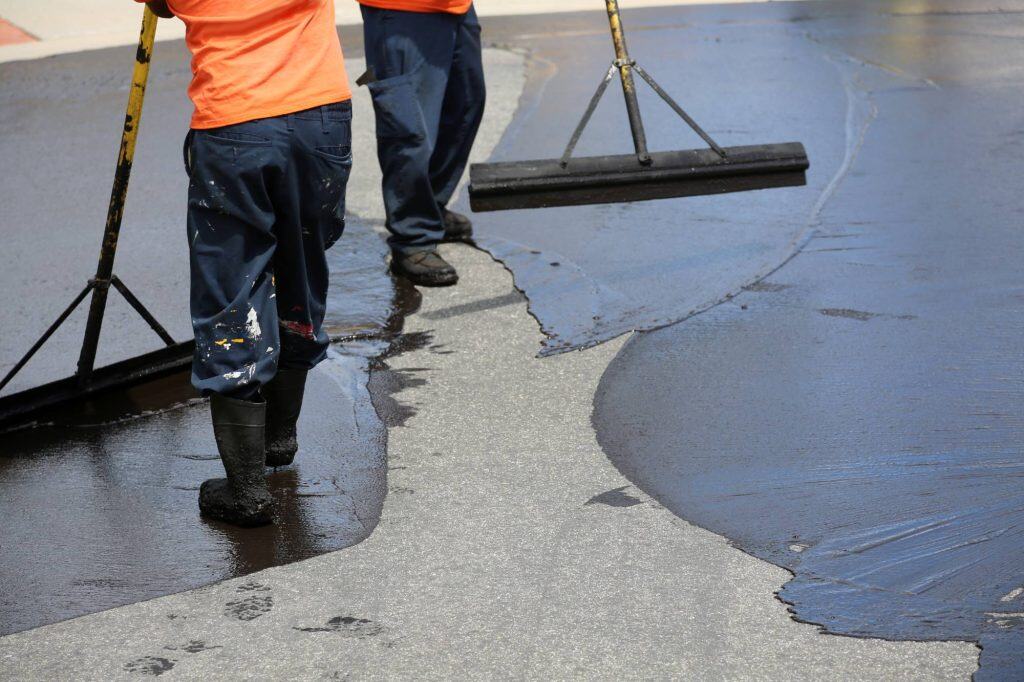
When you see “blacktop cost” broken down, materials and labor are separate line items for good reason. They’re affected by completely different factors.
Asphalt material pricing fluctuates with oil prices since it’s petroleum-based. In 2026, you’re looking at roughly $100 to $200 per ton for quality hot mix asphalt. A typical residential driveway needs 7 to 15 tons depending on thickness and square footage. We recommend 2 to 3 inches of compacted asphalt for residential driveways, though you might go thicker if you’re parking heavy trucks or RVs regularly.
The base layer underneath your asphalt matters just as much as the surface. You need a stable foundation of crushed stone or gravel, which adds another $0.50 to $1 per square foot. Skip this step or use inferior materials, and you’ll see cracks and settling within a year or two. That’s where cheap quotes often cut corners.
Labor costs in New Jersey run higher than the national average—about 15 to 25% more according to recent construction wage data. You’re paying for crews who know how to handle northern New Jersey’s soil conditions, understand proper drainage for our freeze-thaw cycles, and have the equipment to do the job right. A professional installation on a 600-square-foot driveway typically takes one to two days from start to finish, but that includes site prep, base work, asphalt application, and compaction.
The labor portion also covers things most homeowners don’t think about until they become problems. Proper grading so water drains away from your foundation. Smooth transitions where your driveway meets the garage, sidewalk, or street. Edge work that prevents crumbling. These details separate a driveway that lasts 20 years from one that needs major repairs in five.
Hidden Costs That Change Your Total
The blacktop cost per square foot you see advertised rarely includes everything you’ll actually pay. Understanding what’s extra helps you compare quotes accurately and avoid budget surprises.
Removing your existing driveway costs $1 to $3 per square foot depending on what’s there. Old asphalt breaks up relatively easily, but concrete requires more labor and heavier equipment. If your current driveway is badly deteriorated, removal isn’t optional—you can’t just pave over a failing base and expect good results.
Grading and excavation add $5 to $10 per square foot if your property needs significant work. Maybe your driveway slopes toward your house instead of away from it. Maybe there are low spots where water pools. Maybe the soil is too soft to support pavement without stabilization. These aren’t upsells—they’re necessary fixes that prevent your new driveway from failing prematurely.
Permits run $50 to $200 in most Sussex County municipalities, though some towns require engineering plans for larger driveways, which can add $500 to $1,500. We handle permit applications, but you’re paying for that service one way or another.
Drainage solutions vary widely in cost. Simple grading might be included in your base price. Installing a catch basin or French drain to handle serious water issues can add $100 to $1,000 or more. But ignoring drainage problems is expensive in the long run—water is the number one enemy of any paved surface.
Tree or stump removal costs $750 to $2,000 per tree if you need to clear space for your driveway. Curbing or edging adds $5 to $15 per linear foot but helps prevent edge crumbling and gives your driveway a finished look. These extras aren’t necessarily required, but they’re worth understanding when you’re comparing total project costs.
The contractors who give you the lowest initial quote often leave these items out. Then halfway through the job, you’re hearing about “unforeseen conditions” that require more money. A detailed quote that includes all likely costs might look higher initially but saves you from those conversations later.
Want live answers?
Connect with a Platinum Paving expert for fast, friendly support.
Concrete or Asphalt Cheaper: The Real Cost Comparison
When you’re deciding between blacktop and concrete, the cost difference isn’t just about the installation price. You’re comparing two different investments with different upfront costs, maintenance requirements, and lifespans.
Asphalt costs less to install—typically 30 to 50% less than concrete. For that same 600-square-foot driveway, you might pay $3,000 to $7,200 for asphalt versus $4,800 to $9,000 for concrete. That upfront savings is real money you can use elsewhere.
But concrete lasts longer. A well-maintained concrete driveway can give you 30 to 40 years or more, while asphalt typically lasts 15 to 30 years. Concrete also requires less frequent maintenance, though when it does need repairs, they’re usually more expensive and harder to blend seamlessly.
The question isn’t which is cheaper in absolute terms. It’s which makes more sense for your situation, your budget, and how long you plan to stay in your home.
Upfront Investment: What Each Material Costs
Asphalt installation runs $5 to $12 per square foot in Sussex County, putting most residential driveways in the $3,000 to $7,200 range. Concrete costs $6 to $15 per square foot, or roughly $3,600 to $9,000 for the same size driveway. That’s a difference of $600 to $1,800 upfront for a typical project.
The gap widens if you want decorative options. Plain asphalt is plain asphalt—you get that classic black surface. Concrete offers more customization with stamped patterns, borders, and color options, but those upgrades push costs to $12 to $18 per square foot. Stamped asphalt exists but isn’t as common and runs $12 to $17 per square foot.
For homeowners working with a tight budget or a longer driveway, that upfront cost difference matters. A 1,000-square-foot driveway could cost $5,000 to $12,000 in asphalt versus $6,000 to $15,000 in concrete. That extra $1,000 to $3,000 might be money you’d rather put toward other home improvements.
Installation timelines also differ. Asphalt can be driven on within 24 to 48 hours after installation. Concrete needs seven days to cure before you can use it. If you can’t park on the street for a week, that practical difference might influence your decision as much as cost.
Climate plays a role too. Asphalt performs better in New Jersey’s freeze-thaw cycles because it’s flexible. It expands and contracts with temperature changes without cracking. Concrete is rigid, which makes it prone to cracking in extreme cold or when de-icing salts break down the surface. For Sussex County specifically, asphalt’s cold-weather performance is a real advantage.

Long-Term Costs: Maintenance and Lifespan
The upfront price is only part of the equation. What you pay over the life of your driveway tells a different story.
Asphalt requires sealcoating every three to five years at $0.15 to $0.40 per square foot. For a 600-square-foot driveway, that’s $90 to $240 every few years. Over 20 years, you might spend $360 to $1,200 on sealcoating alone. Small crack repairs and patching add another $100 to $400 periodically. If you’re diligent about maintenance, asphalt can last 25 to 30 years. If you neglect it, you might need resurfacing or replacement in 15 years.
Concrete requires less frequent maintenance but isn’t maintenance-free. Sealing every five to seven years costs about $1 to $2 per square foot. Crack repairs are more expensive than asphalt—$3 to $25 per square foot depending on severity—and harder to make invisible. But concrete generally needs fewer repairs if it’s installed correctly with proper drainage.
When you run the numbers over 30 years, concrete often costs less total despite the higher upfront price. A 600-square-foot concrete driveway might cost $6,500 to $8,000 over three decades including occasional repairs. The same size asphalt driveway could run $8,000 to $10,000 when you factor in regular sealcoating, repairs, and possibly one resurfacing.
But that calculation assumes you stay in your home for 30 years and maintain both surfaces properly. If you’re planning to sell in five to ten years, the upfront savings of asphalt might matter more than the theoretical long-term costs. If you hate maintenance tasks and want to minimize upkeep, concrete’s lower maintenance frequency might be worth the extra initial investment.
The choice also depends on what you value. Asphalt repairs are easier and cheaper to do yourself or hire out. A crack in asphalt can be filled with readily available materials for under $50. A crack in concrete often requires professional repair costing $200 to $500 to do properly. Asphalt is more forgiving of minor mistakes. Concrete shows every imperfection.
Making the Right Choice for Your Budget and Property
Understanding blacktop cost means looking beyond the price per square foot. It means knowing what you’re actually paying for, what’s included versus what costs extra, and how your specific property conditions affect the final number.
Asphalt offers lower upfront costs, faster installation, and better performance in New Jersey’s freeze-thaw climate. Concrete costs more initially but lasts longer and requires less frequent maintenance. Neither is universally “cheaper”—it depends on your timeline, budget, and priorities.
We earn your trust by explaining these tradeoffs honestly instead of just pushing you toward the highest-margin sale. When you’re ready to move forward with your driveway project in Sussex County, Morris County, or Somerset County, we provide transparent pricing, quality materials, and the local expertise to handle northern New Jersey’s specific challenges. Reach out when you’re ready for a real conversation about what your project actually requires.