Summary:
Understanding Driveway Layout Options for Large Properties
The shape of your driveway determines how well it functions. Straight driveways work fine when your house sits close to the road, but most large properties in Sussex County have homes set back from the street. That distance changes everything.
Circular and semi-circular layouts eliminate the need to back out onto the road. You pull in, loop around, and drive out facing forward. That’s not just convenient—it’s safer, especially on rural roads where traffic moves faster and visibility can be limited. These layouts also give you a natural spot for guests to drop off passengers near your front door without blocking the main traffic flow.
Long straight driveways with turnaround areas at the end offer another option. You get a dedicated space to turn vehicles around without the full footprint of a circular drive. The key is making sure that turnaround area is actually large enough for the vehicles you use, not just a compact car.
How Much Space Does a Circular Driveway Really Need

Circular driveways look impressive, but they require real estate. You need at least 110 feet from your street to your garage to make a full circle work properly. That’s not just a suggestion—it’s the minimum distance that allows vehicles to navigate the curve without cutting corners or driving on your lawn.
The turning radius matters just as much as the overall length. Most family vehicles, including SUVs and pickup trucks, need a 25 to 30-foot turning radius to maneuver comfortably. Anything tighter forces drivers to make multiple adjustments, which defeats the purpose of having a circular layout in the first place.
Width is the other critical measurement. A circular driveway should be at least 15 feet wide throughout the curve. That gives vehicles enough room to turn without their wheels leaving the pavement. If you plan to have cars parked along the circle while others drive through, you’ll want to widen sections to 20 or even 24 feet in key areas.
Half-circle or horseshoe designs require less total space—you can work with properties that have 55 to 60 feet of frontage. These connect both ends to the street, creating two access points. One serves as your entrance, the other as your exit. You still get the benefit of pulling through instead of backing out, but in a more compact footprint.
The center of your circular driveway offers a natural spot for landscaping. A well-designed island with low-maintenance plantings adds visual interest without creating maintenance headaches. Just keep plantings low enough that they don’t block sightlines when you’re driving through.
Turnaround areas for straight driveways need to be at least 10 feet by 20 feet for a single vehicle, or 20 feet by 20 feet if you want space for larger vehicles or multiple cars. These dimensions aren’t arbitrary—they’re based on the actual space vehicles need to complete a three-point turn without backing onto grass or landscaping.
Driveway Width Requirements for Multiple Vehicles and Parking Flow
Width determines whether your driveway functions smoothly or creates daily frustration. A single-lane driveway can be as narrow as 9 to 10 feet, but that only works if you never have two vehicles needing to pass each other or park side by side.
For properties where multiple family members come and go at different times, a 12-foot width gives you just enough room for two compact cars to squeeze past each other carefully. It’s functional but tight. If you regularly drive larger vehicles—trucks, SUVs, or anything with extended mirrors—that 12-foot width starts feeling cramped quickly.
A 16 to 18-foot width is where driveways start feeling comfortable for two-way traffic. Vehicles can pass without anyone needing to slow to a crawl or worry about clipping mirrors. You can also park one vehicle off to the side without completely blocking the lane.
For properties that host gatherings or have teenage drivers who’ll eventually need their own parking spots, consider widening sections near the house to 20 or 24 feet. This creates a natural parking area that doesn’t block the main traffic flow. Guests can park, and other vehicles can still get to the garage without playing automotive Tetris.
Long driveway paving on rural Sussex County properties faces a specific challenge: the cost increases with every foot of width over hundreds of feet of length. A driveway that’s 500 feet long and 12 feet wide requires 6,000 square feet of asphalt. Widen that same driveway to 16 feet and you’re at 8,000 square feet—a 33% increase in material and installation cost.
That’s where strategic widening makes sense. Keep the main run at 10 to 12 feet, then widen to 18 or 20 feet near the house where parking and turnaround space actually matter. You get the functionality you need without paving areas that only serve as extra width most of the time.
Consider how emergency vehicles access your property too. Fire trucks and ambulances need adequate width and turning radius. Most fire departments require at least 12 feet of width and specific turning capabilities. If your property sits far from the road, confirming these requirements before finalizing your layout can save you from discovering access problems during an actual emergency.
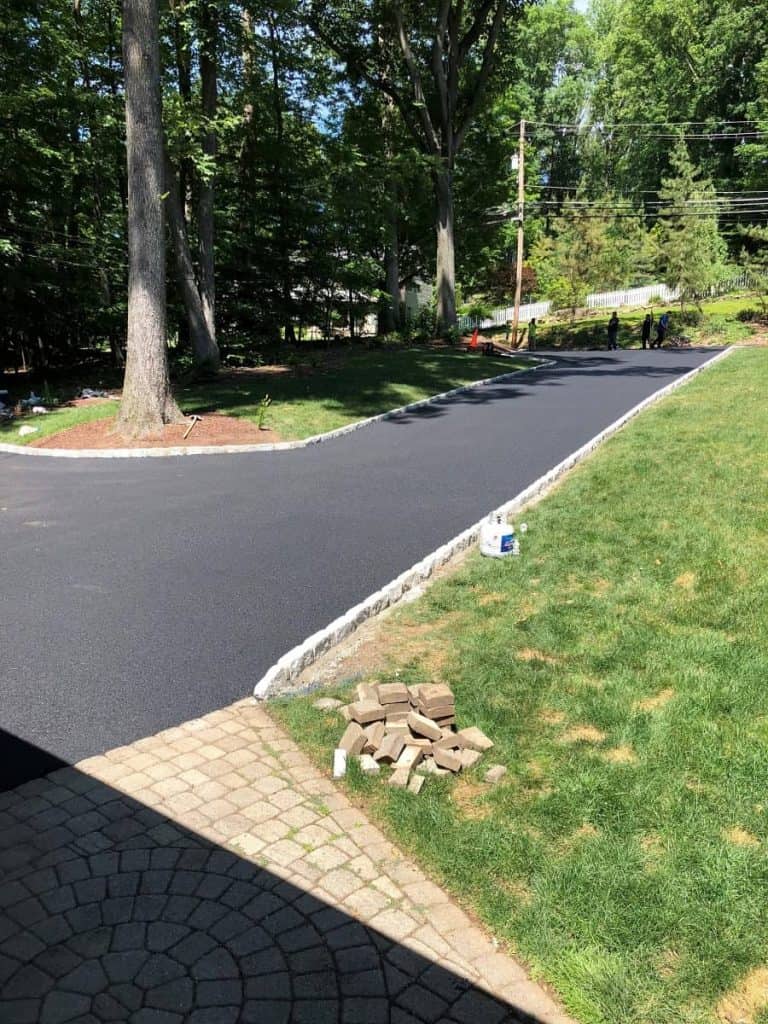
The edge treatment of your driveway affects both appearance and longevity. Asphalt needs proper edge support to prevent crumbling. Some homeowners extend the asphalt a few inches beyond the planned driving surface and let grass grow up to it. Others install Belgian block, concrete curbing, or gravel shoulders. Each approach has cost and maintenance implications, but all beat letting asphalt edges break down because they lack support.
Want live answers?
Connect with a Platinum Paving expert for fast, friendly support.
Drainage Solutions for Large Driveway Paving Projects
Water ruins driveways. It seeps into cracks, freezes, expands, and breaks apart asphalt from the inside out. On large properties with long driveways, drainage isn’t something you can address as an afterthought—it needs to be built into your layout from the start.
Your driveway should slope away from your house and any structures. That sounds obvious, but on properties with varied terrain, achieving the right slope throughout the entire length requires careful grading. The goal is to direct water toward the street, into swales, or toward designated drainage areas—anywhere except pooling on the pavement or running toward your foundation.
Properties with sloped driveways face their own challenges. Water runs downhill fast, and if your driveway descends toward your house, you need a plan to intercept that water before it reaches your garage or foundation. That’s where channel drains, French drains, or catch basins come into play.
Managing Water Runoff on Sloped and Long Driveways
Channel drains work well for driveways with consistent slope. These linear drains with grated tops capture water flowing across the surface and redirect it into underground piping. You install them at the bottom of slopes, near property entrances, or anywhere water naturally sheets across your driveway.
The grated top supports vehicle traffic while allowing water to enter the drain below. The system connects to underground pipes that carry water to an appropriate discharge location—usually a drainage ditch, storm sewer connection, or designated runoff area on your property. Channel drains handle large volumes quickly, preventing the pooling and erosion that occur when water has nowhere to go.
French drains address subsurface water issues. If water tends to pool along the edges of your driveway or you have areas where groundwater seeps up through the base, a French drain can intercept that water before it undermines your pavement. These consist of perforated pipe surrounded by gravel, installed in a trench alongside or beneath your driveway. Water enters through the perforations, flows through the pipe, and discharges away from the problem area.
Swales offer a simpler, more natural-looking drainage solution for some properties. A swale is a shallow, vegetated channel that runs alongside your driveway. It captures runoff and allows it to slowly infiltrate back into the ground. Swales work particularly well when the land on one or both sides of your driveway slopes toward the pavement. Instead of letting that hillside runoff flow down your driveway, the swale intercepts it and manages it before it becomes a problem.
The slope of your driveway itself affects drainage effectiveness. Ideally, driveways should have a grade of less than 12%. A gentle to moderate slope ensures water flows toward drainage points without moving so fast that it causes erosion. If your property’s natural terrain creates a steeper grade, you may need to design switchbacks or curves that lengthen the driveway’s path and reduce the effective slope.
Culverts become necessary when your driveway crosses a natural drainage path—a creek, swale, or area where water flows during storms. A culvert is essentially a large pipe installed beneath your driveway that allows water to continue flowing through its natural path without washing over or under your pavement. Installing a culvert requires excavating part of your driveway route, but it’s far better than dealing with erosion and washouts every time it rains.
Proper base preparation plays a huge role in drainage performance. Before any asphalt goes down, the subgrade needs to be properly compacted and graded. A well-prepared base with appropriate slope allows water to drain through and away from the pavement structure. Cutting corners on base prep to save money up front almost always leads to drainage problems and pavement failure down the road.
Preventing Water Damage and Extending Driveway Lifespan
New Jersey’s freeze-thaw cycles are particularly hard on asphalt. Water that seeps into small cracks freezes when temperatures drop. Ice expands with significant force, widening those cracks. When temperatures rise, the ice melts, and more water seeps deeper into the enlarged cracks. This cycle repeats throughout winter and early spring, progressively destroying pavement that might have lasted decades with proper drainage.
Sealcoating provides a protective barrier that helps prevent water infiltration. Applied every three to five years, sealcoat fills in minor surface cracks and creates a water-resistant layer over your asphalt. It’s not a substitute for proper drainage, but it’s an important part of long-term maintenance that extends pavement life significantly.
Catch basins work well in areas where water pools consistently. These consist of an in-ground box beneath a grate, similar to storm drains you see in streets. Water flows through the grate into the basin, then gets redirected through connected piping to a discharge point. Catch basins make sense at the bottom of sloped driveways or in low spots where water naturally collects.
The timing of your installation affects drainage performance too. Asphalt needs to be installed when temperatures are appropriate for proper compaction. Cold weather causes asphalt to harden too quickly, preventing proper compaction and adhesion. Extreme heat makes it too soft. Rainy or humid conditions delay curing. Scheduling your driveway paving during favorable weather conditions—typically late spring through early fall in New Jersey—ensures better long-term performance.
Edge drainage deserves attention on long driveway paving projects. Water that runs off the sides of your pavement can erode the shoulders and undermine edge support. Some contractors install perforated pipe along driveway edges, surrounded by gravel and covered with topsoil. This edge drain captures water before it causes erosion and directs it to designated discharge points.
Crown or cross-slope refers to building a slight peak along the centerline of your driveway so water drains off both edges rather than running down the middle. This works well on longer driveways where you want to prevent water from gaining speed as it flows downhill. The crown is subtle—usually just a couple of inches—but it effectively spreads water to the sides where it can be managed through edge drains or swales.
Understanding where water goes after it leaves your driveway matters too. You can’t simply direct all your runoff onto a neighbor’s property or into areas that will create new problems. Some municipalities have specific requirements about stormwater management for new or significantly modified driveways. Checking these requirements before you finalize your drainage plan prevents issues with permits and future code compliance problems.
Planning Your Large Property Driveway Paving Project
The right driveway layout for your large property in Sussex County comes down to matching design to how you actually use your space. Turnaround areas, adequate width, and proper drainage aren’t extras—they’re the fundamentals that determine whether your driveway functions well for decades or creates ongoing problems.
Circular layouts work when you have the space and want to eliminate backing out onto rural roads. Straight driveways with properly sized turnaround areas offer similar functionality in a more compact footprint. Width needs to account for the vehicles you drive and whether multiple cars need to pass or park simultaneously. Drainage requires planning based on your property’s slope, soil conditions, and where water naturally flows.
Getting these decisions right the first time saves you from expensive corrections later. If you’re planning driveway paving for a large property, we can help you evaluate your site conditions and design a layout that actually works for your needs.